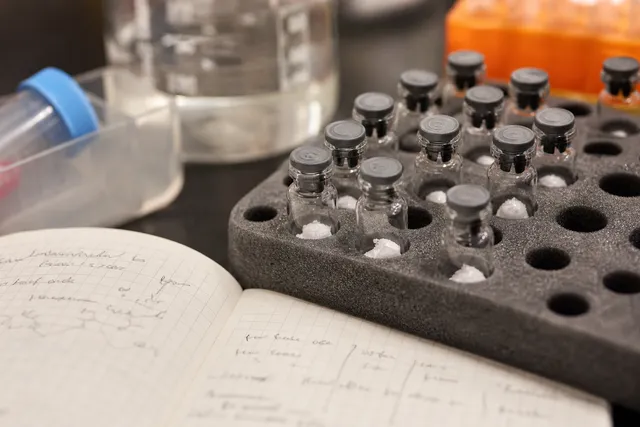
Ipamorelin and CJC-1295 are research peptides often mentioned together because both relate to growth hormone (GH) release. They do not work through the exact same lock-and-key pathway.
CoreVials listings for ipamorelin and CJC-1295 (No DAC) are for laboratory research only, not for human or animal use.
What is ipamorelin?
Ipamorelin is a short synthetic peptide that acts at the ghrelin receptor (often called GHS-R1a). Ghrelin is sometimes nicknamed the hunger hormone, but that receptor also helps control GH pulses.
A classic 1998 characterization by Raun and colleagues described ipamorelin as a selective GH secretagogue in animal models. "Selective" here means GH release without the larger cortisol and prolactin shifts seen with some older related compounds in those experiments.
What is CJC-1295?
CJC-1295 is a growth hormone-releasing hormone (GHRH) analog. It targets the GHRH receptor pathway, which is a different receptor from the ghrelin receptor.
Important detail for catalog research: some published human pharmacology used a longer-acting DAC form of CJC-1295. CoreVials lists a No DAC research material. Those forms are related but not identical in half-life behavior, so papers must be matched carefully to the form being discussed.
Why do people talk about pairing them?
The pairing idea comes from pathway logic:
- CJC-1295-type tools push on the GHRH receptor lane
- Ipamorelin pushes on the ghrelin receptor lane
Older human physiology work with GHRH plus a GH-releasing peptide showed that combining those two lanes can produce a larger GH response than either lane alone under lab conditions. That supports a mechanistic rationale.
It does not automatically prove that every modern consumer-style "stack" protocol has been validated in a large randomized trial of the exact CJC-1295 + ipamorelin pair.
What evidence is strong vs thin?
Stronger areas:
- Receptor identity and GH-release pharmacology for each class
- Selectivity characterization for ipamorelin in early animal work
- Human PK/PD data for CJC-1295 DAC forms in small studies
Thinner areas:
- Large outcome trials of the exact combination
- Long-term safety datasets for research-use discussions outside controlled trials
- Assuming IGF-1 changes equal meaningful long-term outcomes
Related CoreVials reading
If you are mapping GH-axis research tools, also compare sermorelin and tesamorelin. For beginner peptide basics, see research peptides for beginners.
References
- Raun, K., et al. (1998). Ipamorelin, the first selective growth hormone secretagogue. European Journal of Endocrinology. PubMed
- Teichman, S.L., et al. (2006). Prolonged stimulation of growth hormone (GH) and insulin-like growth factor I secretion by CJC-1295, a long-acting analog of GH-releasing hormone. Journal of Clinical Endocrinology & Metabolism. Read the study
- Bowers, C.Y., et al. and related GHRH + GHRP synergy physiology literature showing complementary GH-release pathways in controlled human experiments.